
Entrepreneurship

Picto
Entrepreneuriat
Code couleur
safran

No. 1 - Food and economic security from A to Z

Contenu
Image 4:1
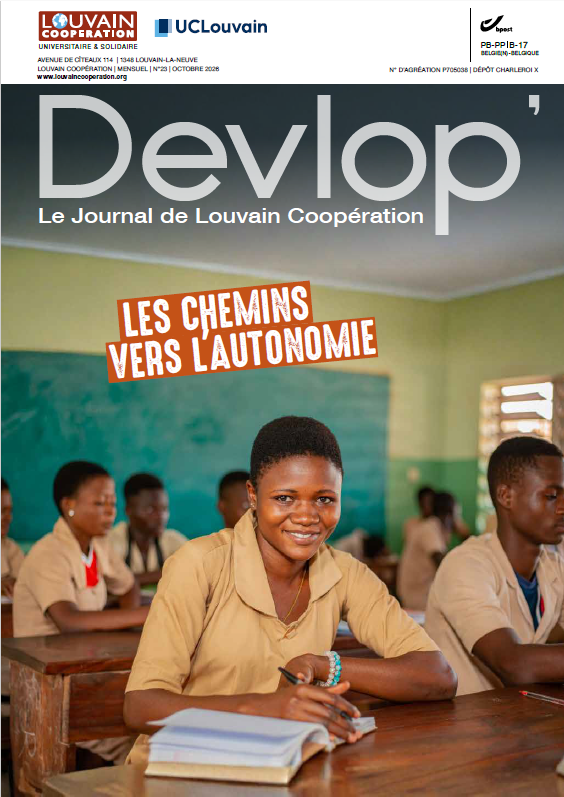
Dévlop' 1
Contenu
Texte

Food and economic security from A to E

Contenu
Texte

Edito

You cannot create a different world with indifferent people.

We are delighted to share with you this summary of our actions and projects.

The history of Louvain Coopération spans decades and four continents. Through political, social, economic and technological changes, we have transformed our practices, projects and methodologies to ensure that our actions continue to match our ambitions, while remaining close to the populations of the South.

Today, the NGO sector is positioning itself more and more precisely: the Paris Declaration on Aid Effectiveness, monitoring and evaluating progress, adapting to national situations, the Istanbul Principles, with a view to jointly creating knowledge and strengthening civil societies around the world.

It is in this spirit and with your support that we want to look at the present and play a role vis-à-vis the political and economic actors and future citizens who are being trained here at UCL. If we can contribute to a better world, it is in particular by encouraging students to imagine their civic and professional paths within a framework of solidarity and responsibility.

Once again this year, many of you have actively supported all these projects. You, our donors, our partners, public and private funders, and all those who place their trust in us. We would like to express our sincere gratitude on behalf of the entire Louvain Coopération team!

Félix Vanderstricht

Block

No. 7 - Transforming products and everyday life

Contenu
Image 4:1
7 - transforming products and everyday life
Contenu
Texte

dossier transformation

Contenu
Texte

Edito

Academic for the future

As the first executive to retire, I have been given the privilege of writing this editorial, which I am dedicating to the opportunity represented by our NGO's academic roots.

During my few years with this organisation, I have observed and contributed to a number of initiatives that have convinced me of the added value of being a university-based NGO. In my opinion, the most interesting and relevant interactions with UCLouvain are those that involve and strengthen organisations and universities in the South. As sustainable development is primarily a matter for the local citizens concerned, our partnership with UCLouvain must rise to the challenge of strengthening the local capacities of the Global South to formulate and implement its own development policies: moving from dependence on ideas from the Global North to interdependence with ideas from the Global South.

I therefore encourage the team to support the research and innovation capacities of our partners in the Global South. This is the best guarantee of ownership of their development and adaptation of appropriate strategies to their context. In the North, many university researchers participate in the multi-stakeholder processes that guide our own societal transitions. Why not contribute to this capacity building in the South? The challenge for Louvain Coopération would then be to develop more and more collaborations involving NGOs, students and university researchers from the South.

In this way, we can move towards increasingly equal partnerships and improve our social anchoring within the academic community.

The processes of transformation in agricultural production presented in this issue of Devlop' are at the heart of this issue of ownership.

Patrick Vanderhulst
Expert in mutual health insurance

n°21 Devlop'

Contenu
Image 4:1
Devlop' n°21
Contenu
Texte

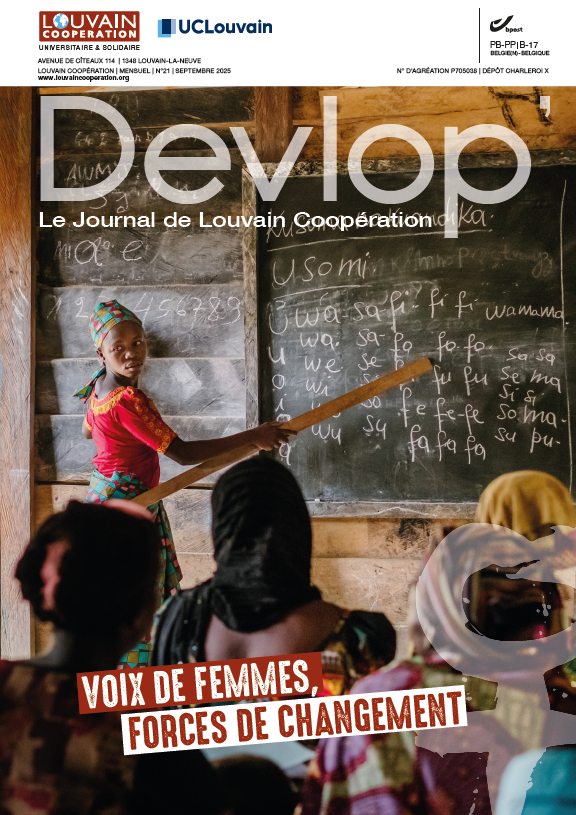
Devlop' : voix de femmes, foces de changement

Contenu
Texte

Edito

Women's economic leadership: an unfinished emancipation

In the past, figures such as Olympe de Gouges, with her Declaration of the Rights of Woman and the Female Citizen in 1791, laid the foundations for modern feminist demands for civil and economic equality. Centuries later, the acquisition and respect of women's fundamental rights to economic independence remain an unfinished battle throughout the world. At Louvain Coopération, our commitment to women's economic leadership stems from this observation: true equality cannot be achieved without dismantling the stereotypes and domestic barriers that hinder women's emancipation, and without transforming support structures and the division of labour to make them more equitable.

In the DRC, with the Observatoire de recherche sur l’Entrepreneuriat Féminin Durable Pour Elles (Research Observatory on Sustainable Female Entrepreneurship for Women), we are working to identify and overcome the socio-cultural barriers limiting female entrepreneurship. Our programmes to improve the financial independence of women fishermen in Madagascar and female entrepreneurship in South Kivu aim to empower those who are marginalised by traditional economic structures. When we support the socio-professional inclusion of single mothers in Haiti, we take into account the fact that behind women's access to leadership roles lies an often overlooked reality: the double burden that many women face, combining paid employment with domestic work, which is a major obstacle to their economic empowerment.

In Belgium too, how can we reconcile women's personal and professional fulfilment without trapping them in a spiral of exhaustion? Here, as elsewhere, is our job not simply to contribute to a reassessment of the place of human beings in our economies in order to rebuild our social contract? These are, in any case, central questions at Louvain Coopération, which drive our work and our thinking. And we are happy to share them with you in the following pages.

Sandrine Laroche
Project Monitoring Officer

Contenu
Texte

N°21 Voix de femmes, forces de changement

Texte

Receive Journal No. 21

Contenu
Block