Democratic Republic
of the Congo
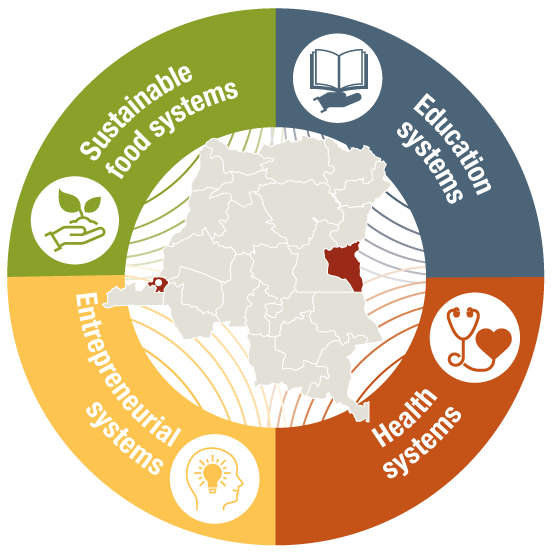
South Kivu Province
and city of Kinshasa
11
partners
4,222
people affected in 2025
Louvain Cooperation in the DRC
Partners and Funders
Partners:
- Action Sociale et d’Organisation Paysanne « ASOP »
- Guichet d’Economie Local Sud-Kivu « GEL/SK »
- Fonds Social du Kivu « FSKi »
- Division Provinciale de la santé Sud/Kivu « DPS S/K »
- Bureau Central de la Zone de santé de Bagira « BCZS/Bagira »
- Programme Katana « PK »
- Centre d’Appui Médico Psychosociale/ACAD « CAMPS »
- Ndako Ya Biso « NYB »
- Œuvre de Reclassement et de Protection des Enfants de la Rue « ORPER »
- Don Bosco Bukavu
- Bana Ya Poveda
- Terres rouges Bénin
Funders:
- Expertise France
- DGD
- UE
- Enabel
- Région Bruxelles Capitale
- FAO
- OVO (Lotus Bakeries et Van Breda Risks and Benefits)
- AFLAM
- Fondation Roi Baudouin
- WBI
Strengthening the health system
- Project duration: 2022 - 2026
Our Objective:
To improve the physical, mental and social well-being of the people of South Kivu by strengthening access to quality, person-centred healthcare that integrates mental health and the prevention of non-communicable diseases such as diabetes and hypertension.
Our Actions:
- Integration of mental health and nutrition into primary healthcare;
- Training of healthcare personnel (doctors, nurses, psychologists, laboratory technicians) in person-centred care;
- Support with essential medicines for the management of diabetes, hypertension and mental disorders;
- Emergency support with healthcare equipment and medicines for health centres following the conflict in South Kivu;
- Strengthening governance and the capacities of local health structures;
- Support for community participation through the involvement of health committees, patient groups and local leaders;
- Awareness-raising and support for vulnerable groups, particularly street children;
- Support for regulators (health administration, supervisory staff) to ensure consistent and sustainable oversight.
Our Impact:
This project improves the quality of care for thousands of patients and reduces the stigma associated with mental health. It strengthens the capacities of healthcare providers at all levels, promotes the inclusion of the most vulnerable, and fosters a more humane, preventive, and participatory approach to care.
Support and reintegration of children and young people living on the streets
Four different projects are currently aimed at supporting and reintegrating street children and young people in Kinshasa. These are the “Street Children Project”, funded by Belgian Cooperation, “Tremplin”, funded by Enabel, the Belgian development agency, “Elenge na Mosala”, funded by the Brussels-Capital Region, and finally the “Learning Pathway”, funded by the King Baudouin Foundation.
- Project duration: 2022 - 2026
Our objective:
To promote the empowerment, socio-professional reintegration and dignity of young people living on the streets of Kinshasa by offering them a learning, training and support programme tailored to their needs.
Our actions:
- Reception and support for young people living on the streets, more than half of whom are girls;
- Vocational training in informal trades (cooking, beauty, cutting and sewing, electricity, mechanics, etc.)
- Practical internships with master craftsmen in the informal sector;
- Additional training in digital marketing, soft skills (behavioural and social skills) and entrepreneurship;
- Distribution of integration kits containing useful tools to help young people who have demonstrated strong motivation and empowerment skills to start their own businesses;
- Development of an inclusive approach promoting girls' access to traditionally male-dominated trades;
- Integration of a research component with UNIKIN (University of Kinshasa) to analyse integration pathways;
- Capacity building for teams at partner centres (psychosocial support, career guidance, integration).
Our Impact:
These projects offer a concrete alternative to exclusion for particularly vulnerable young people. They provide them with useful skills, recognise their potential and reconnect them with their economic and social environment. In this way, they help to build dignified and sustainable life paths.
The context of the DRC
The Democratic Republic of the Congo (DRC) is a vast country rich in natural resources and biodiversity. Despite this considerable potential, the majority of the population lives in extreme poverty. Armed conflict, political instability, structural poverty and limited access to essential services are major obstacles to sustainable development.
A vulnerable population
- Prolonged conflicts, political instability and poor governance
- Persistent humanitarian crisis
- 62% of the population lives on less than €2 per day (60 million people)
A worrying health situation
- 43% of children under the age of 5 suffer from chronic malnutrition
- 6 million children are stunted
- Maternal mortality rate: 693 deaths per 100,000 live births
- Only 4% of people have health coverage
Numerous challenges in terms of employment and education
- 70% of the working population is employed in agriculture
- Only 66.5% of adult women are literate (2018)
- Low representation of women in decision-making positions
Natural resources at risk
- The DRC is home to the largest portion of tropical rainforest in Africa
- More than 5% of its primary forests disappeared between 2002 and 2020
Creative spark: supporting socio-cultural projects
- Project duration: 2025–2027
Our objective
To support, strengthen and promote cultural and creative initiatives led by local young people, by supporting emerging artistic careers and innovative projects with a strong social impact.
Our actions
- Ensuring the organisation, support and monitoring of socio-cultural projects carried out by youth associations.
- Personalised support (mentoring, workshops, training) from professional coaches in the cultural or sports sector who respond to their needs and interests;
- Networking and exchanges with other young people and professionals in the cultural or sports sector;
- The possibility of receiving financial support for project development (maximum duration 6 months);
Our impact
Through personalised support from professional coaches in the cultural or sports sector, this project enables young professionals in the DRC to strengthen their skills in the cultural sector and creative economy, thereby promoting a lasting impact on their development and social cohesion.
Ensemble pour elles
- Project duration: 2025
Our objective:
To improve entrepreneurial skills, profitability and job creation for women entrepreneurs in the Bukavu region (South Kivu) while promoting their social inclusion and resilience in a challenging context.
Our actions:
- Support for 100 women entrepreneurs active in:
- Basic food trade
- Agri-processing
- Crafts
- Transport
- Local services
- Training in entrepreneurship, administration, finance, HR management and digital marketing
- Organisational diagnostics incorporating gender analysis
- Awareness-raising on the legal framework, the environment, gender and climate change
- Integration of the OIE (Environmental Integration Tool) approach to strengthen the positive ecological impact of businesses
- Creation of a Safe Space in Bukavu including:
- A training area
- A psychosocial support space
- A childcare centre
- Emergency and comfort equipment
- Construction of the ‘Pour Elles’ house with our local partner, the Guichet Économie Locale du Sud-Kivu (South Kivu Local Economy Office)
- Establishment of mobile training teams, mainly composed of women
- Organisation of discussion forums and awareness-raising activities on:
- Gender stereotypes
- The fight against gender-based violence
- Positive masculinity
- Social norms and women's rights
Facilitating local initiatives in the DRC
- Project duration: 2023-2026
Our objective:
To strengthen the capacities of civil society organisations (CSOs) in the DRC to promote a more inclusive and participatory democratic space. The project supports initiatives in the areas of governance, human development and sustainable development.
Our actions
- Establishment of the Local Initiative Support Service (SAIL), a resource centre for CSOs in the 26 provinces of the DRC;
- Training and support for 120 microprojects across the country;
- Funding for local microprojects up to €60,000 for a maximum duration of 12 months each;
- Support for concrete initiatives on a variety of themes:
- Peacebuilding (Western Kasai)
- Literacy and integration of young people (Kinshasa)
- Care for street children (Kinshasa)
- Detection of complications related to sickle cell anaemia (Kinshasa)
- Cultural promotion: jazz and piano festivals (Kinshasa)
- Expansion of hospital maternity wards (Kisenso)
- Economic resilience of women in mining areas (Ituri)
- Agribusiness for young people (Central Kongo)
- Food security and access to water (Kwilu)
- Urban sanitation and environmental education (Kinshasa)
- Youth engagement on climate change (North Kivu)
- Participatory land governance (South Kivu)
Our Impact:
This project helps to revitalise Congolese civil society in all provinces by promoting local initiatives. It strengthens participatory governance, improves access to fundamental rights and gives a voice to grassroots actors, particularly young people and women.
Inclusive vision: access to basic social services for the most vulnerable
- Project duration: 2022 - 2026
Our Objective:
To promote equitable access to quality basic social services — eye care, inclusive education and vocational training — for vulnerable populations, particularly women, visually impaired children and street youth.
Our Actions:
- Training partner service providers, particularly women, on social services and eye care;
- Supporting basic education for visually impaired children and vocational training for young people living on the streets;
- Logistical support and equipment for partner organisations (medical equipment, teaching materials, etc.);
- Support for infrastructure adapted to the specific needs of women and people living with disabilities;
- Strengthening the regional distribution centre in Lubumbashi to ensure the supply of medicines and inputs related to eye care;
- Social mobilisation for the enrolment of visually impaired children in school and access to vocational training;
- Establishment of sustainable mechanisms to facilitate access to care in the targeted provinces;
Our Impact:
This project helps reduce inequalities in access to healthcare and education in the DRC. It supports the inclusion of the most vulnerable populations in appropriate healthcare and learning pathways, while strengthening the capacities of local structures for a sustainable and equitable response.
Observatory for Women
Our objective
To contribute to the economic empowerment of women and thus help reduce gender inequality by supporting women-led entrepreneurial initiatives.
Our actions
- Organisation of round tables and discussion groups on female entrepreneurship;
- Strategic support for structuring the Observatory's economic model and seeking funding and strategic partnerships;
- Completion of postdoctoral work on one of the issues identified as a priority;
- Centralisation of research and action research, relevant activity reports, and grey literature on female entrepreneurship in the DRC;
- Supporting dissertations written by pairs of Congolese, Belgian and French students, in partnership with Belgian and French universities and colleges;
- Support for internships within the Observatory;
- Production of digital content based on research findings;
- Awarding of the Observatory's Prize for Research on Sustainable Female Entrepreneurship For Them to the best research carried out by a student from a Congolese university.
Our impact
This project capitalises on the experience of women entrepreneurs and the lessons learned from programmes on women's economic empowerment, combining them with scientific research and incorporating an approach that takes environmental, social and climate aspects into account.
Promoting a Sustainable Food System
- Project duration: 2022 - 2026
Our Objective:
To promote sustainable and inclusive economic and agricultural models by working across the entire value chain. We promote agroecological practices, support entrepreneurship among young people and women, and strengthen the capacities of local partners for better natural resource management and greater socio-economic resilience.
Our Actions:
- Support for the adoption and appropriation of profitable agroecological practices adapted to local contexts;
- Strengthening the entrepreneurial skills of women and young people in innovative economic sectors;
- Literacy, particularly for women, to strengthen their autonomy and leadership;
- Professionalisation of economic activities through training and technical support;
- Promoting biodiversity conservation and the restoration of natural resources in agroecosystems;
- Close support for vulnerable young people to help them integrate into society and the labour market.
Our Impact:
This project strengthens the economic sovereignty of rural communities while preserving the environment. It promotes the empowerment of young people and women, encourages local innovation dynamics, and improves the resilience of ecosystems and populations to multiple crises.
Contact : info-kinshasa@louvaincooperation.org and info-bukavu@louvaincooperation.org
Find out more about our work in the DRC
More news +
More vidéos +

More documents +
FAQ
Effective responses combine slope and bank protection, flood control structures, reforestation, practical building standards and community warning systems. Prioritising schools, health centres, water points and key roads ensures that vital services are secured first.
Congolese forests play a major role in climate and biodiversity. The most promising approaches combine community forestry, landscape restoration (agroforestry, reforestation), alternatives to wood energy, and compatible income-generating activities (honey, non-timber forest products such as mushrooms, wild fruits and medicinal plants, local ecotourism). Community support increases when the economic benefits are visible and governance is clear.
Concrete levers
- Improved stoves, gas/electricity networks where realistic.
- Landscape plans with simple monitoring of land use changes.
- Profit sharing and local jobs in conservation.
The challenge is to improve continuity (pre-school, primary, secondary) and to bring technical and vocational training closer to local needs: agro-processing, maintenance, energy, construction and public works, logistics, digital services. Short certification courses, work-study programmes, training workshops and adult literacy programmes — taking into account the languages used — promote integration.
The country is organised around a vast central forest basin, surrounded by savannah plateaus and more rugged terrain to the east (Albertine Rift, Great Lakes).
The Congo River and its tributaries form key routes for life and trade, but travel is sometimes hampered by rapids and swampy areas.
This configuration explains the diversity of agricultural systems, fishing practices and marketing channels across different regions.
French coexists with many national and local languages (Lingala, Swahili, Tshiluba, Kikongo, etc.). Adapting information and training to the languages actually used in the workplace improves the uptake of services (health, agriculture, rights). Community organisations and religious networks can be useful intermediaries when regular and respectful dialogue is established.
Realistic plans, budgeting that includes maintenance from the outset, and accountability mechanisms (citizen committees, open data) reinforce service continuity. Cooperation between neighbouring municipalities allows for the pooling of technical functions (water, waste, roads) and improves execution.
Best practices
- Recurring maintenance programmes rather than isolated ‘major projects’.
- Simplified publication of budgets and results.
- Measured and transparent local public-private partnerships.
On a daily basis, it is the service roads, piers, ferries and equipped rural markets that make the difference. Regular maintenance reduces costs and losses. The strengthening of a few road/rail corridors and multimodal river platforms facilitates interregional trade, while digital coverage and mobile payments facilitate the coordination of flows.
The priority is to ensure the continuous availability of inputs, local supervision, maternal and child health, mental health care, malaria prevention and nutrition. Simple risk-sharing mechanisms, combined with WASH (water, sanitation and hygiene) actions, reduce catastrophic expenditure. Monitoring effective coverage allows for rapid adjustments.
Sustainable strengthening of health systems also relies on support for local civil society organisations (CSOs), which play a key role in raising awareness, patient referral, advocacy and citizen oversight. Mechanisms such as the FIL project help to strengthen their capacities, secure their long-term action and structure dialogue with health authorities.
The Congo River network — including the Ubangi, Kasai, Sangha, Lomami and Lualaba rivers — offers significant resources and strategic waterways. At the same time, silting, seasonal turbidity and the lack of auxiliary structures limit irrigation and complicate the process of making water drinkable. Basin plans, canal dredging, catchment protection and better-equipped river platforms are improving access and safety in the long term.
Beyond mineral resources, economic life relies heavily on family farming, artisanal processing, fishing, small businesses and services. Concrete opportunities lie in the local promotion of products (flour, oils, dried fruit, smoked fish), the improvement of local logistics and simple, reliable financing solutions for microbusinesses and SMEs.
Pragmatic approaches:
- Quality and hygiene in processing, simple packaging, labelling.
- Equipped points of sale/markets, price information, mobile payments.
- Local producer-buyer cooperation to secure outlets.
Availability depends on harvests, but food security also depends on income stability and nutritional practices. Diversification (legumes, leafy vegetables), reduction of post-harvest losses (storage, drying, sorting) and school/community gardens improve the quality of diets. The organisation of producers and local purchasing channels makes incomes less unpredictable.
The rehabilitation of hydroelectric assets, the installation of mini-grids (hydro/solar) for secondary centres and solar kits dedicated to productive uses (pumping, cooling, workshops) offer tangible gains. For cooking, combining improved stoves, LPG solutions where logistics allow, and electric cooking in served localities reduces both expenditure and pressure on forests.
Urban growth is rapid in Kinshasa, Lubumbashi, Goma and Kisangani, often outpacing the development of water, sanitation and energy networks.
However, the majority of the country remains rural, with significant distances to markets and basic services.
Adapting solutions to this duality — equipped densification in cities, opening up access and local services in rural areas — is crucial for equitable access.
Which monitoring benchmarks should be chosen to steer the process without overburdening the systems?
A concise but useful dashboard is sufficient: continuity of services (water, health, energy), volumes sold and losses avoided in the supported sectors, integration/employment of young people and women, local budget execution and adoption of resilience practices (agroecology, road maintenance, clean cooking). The aim is to inform decisions quickly.