Food and economic security from A to E
Edito
You cannot create a different world with indifferent people.
We are delighted to share with you this summary of our actions and projects.
The history of Louvain Coopération spans decades and four continents. Through political, social, economic and technological changes, we have transformed our practices, projects and methodologies to ensure that our actions continue to match our ambitions, while remaining close to the populations of the South.
Today, the NGO sector is positioning itself more and more precisely: the Paris Declaration on Aid Effectiveness, monitoring and evaluating progress, adapting to national situations, the Istanbul Principles, with a view to jointly creating knowledge and strengthening civil societies around the world.
It is in this spirit and with your support that we want to look at the present and play a role vis-à-vis the political and economic actors and future citizens who are being trained here at UCL. If we can contribute to a better world, it is in particular by encouraging students to imagine their civic and professional paths within a framework of solidarity and responsibility.
Once again this year, many of you have actively supported all these projects. You, our donors, our partners, public and private funders, and all those who place their trust in us. We would like to express our sincere gratitude on behalf of the entire Louvain Coopération team!
Félix Vanderstricht
Louvain Coopération is active in four areas: healthcare, access to healthcare, development education, and food and economic security.
While development education is mainly aimed at the Belgian public, Louvain Coopération's three other areas of expertise are carried out in the South (see infographic opposite). Food and economic security activities are developed on three continents.
But what does this area cover?
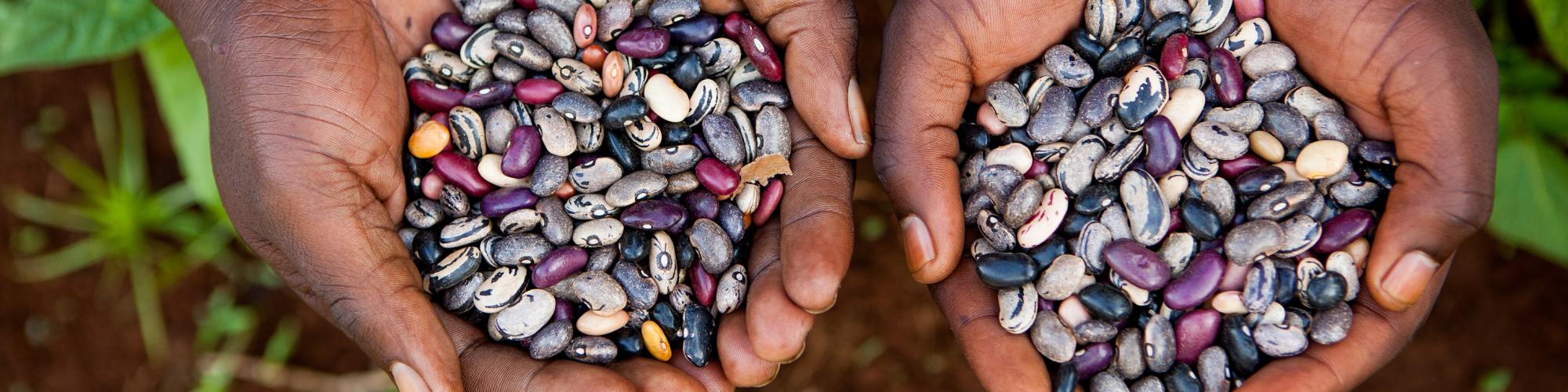
For the United Nations, food and economic security (FES) corresponds to physical, social and economic access to sufficient healthy and nutritious food for the populations concerned, in order to guarantee them a healthy and active life. Quantity, quality, nutrition and economics are therefore at the heart of the concept.
Louvain Coopération is committed to this approach by structuring its FES activities around four areas: 1) supporting producers or entrepreneurs in income-generating activities; 2) improving and diversifying production processes and sources of income; 3) structuring civil society and training populations; and 4) developing cooperatives and unions. Just as it would be utopian to believe that SAE alone could eradicate poverty, it would be naïve to think that a single solution could be transferred from one country to another. Consequently, while Louvain Coopération's intervention is fundamentally consistent, its work varies from one region to another depending on the context, possible synergies and local dynamics and cultures.
In the Democratic Republic of Congo, alongside its support for entrepreneurs (providing equipment, training, etc.), Louvain Coopération has launched a complementary approach known as Mutual Solidarity Funds (MuSo for short).
As their name suggests, these are collective savings funds. MuSo are groups of people who freely associate and regularly pay a fixed contribution in order to build up a common capital. This capital is then used to grant loans to members on the basis of a democratic decision-making process. Similar to traditional tontines, MuSo differ in that they have a triple fund.
The green fund consists of the capital used to grant microloans to members of the mutual society. Most often, loans are used for the development of economic activities (purchase of equipment, seeds, etc.).
But everyday life can sometimes play nasty tricks. In the event of illness, theft or death, unforeseen expenses arise. To help their members through these difficult times, the Mutual Solidarity Funds have created a red fund. This is an emergency fund that provides non-repayable assistance in the event of an emergency or a serious and unforeseen event. Here too, decisions are taken by a vote of all contributing members.
To strengthen the viability of the MuSo, Louvain Coopération initiated their unionisation. In this way, each mutual society contributes to the union of mutual societies. These contributions feed into a third fund, the blue fund. This means that in particularly difficult situations, if funds run out (village affected by a natural disaster, crops compromised, etc.), the MuSo can draw on emergency financial assistance from the blue fund.
The MuSo are now a real success, with more than 500,000 members, two-thirds of whom are women. The green funds alone have accumulated nearly €1 million in savings. They demonstrate that pooling resources, accompanied by solid methodological support, is an effective solution to food and economic security problems.
From a very young age, street children are immersed in a reality that is beyond their comprehension, but also beyond ours.
According to a United Nations report, the living conditions and violence faced by street children in Kinshasa are unimaginable. According to the report, they are a ticking time bomb... Faced with this problem, remaining inactive is not an option! The Louvain Coopération pilot project will be carried out in Kinshasa, where it is estimated that there are more than 25,000 street children. Over a period of three years, 250 children aged between 6 and 18 will be taken into care and supported in their psychosocial rehabilitation. The project guarantees assistance with the basic social and health needs of street children, while at the same time developing a different and innovative approach through the strengthening of psychosocial bonds.
The importance of psychosocial bonds.
To help these children escape the hell of the streets, it is essential to take into account their psychological suffering and trauma. If this suffering is not addressed, it becomes difficult to envisage comprehensive care and the possibility of rehabilitation. Children must regain some self-confidence before they can be reintegrated into their social and family circles.
This project was made possible thanks to a unique partnership between the Monsengwo Foundation, the Leysen family of the Van Breda company, the Entrepreneurs pour Entrepreneurs association and Louvain Coopération. The three-year pilot project started in April and is currently working with a Kinshasa-based care institution, the ORPER association. During the project, other donors who are sensitive to this issue will be contacted in order to increase the number of children benefiting from the project and to involve other care institutions. Locally, it is also essential to raise awareness among these care institutions of the need to listen to and consider the needs of these children who have had a difficult past. This is one of the essential conditions for getting them off the streets for good.
At the beginning of 2015, Louvain Coopération embarked on an awareness-raising initiative through theatrical practices. Inspired by the success of our play at the Universatil festival in February, the term continued with the creation of an academic course on ‘Forum Theatre’.
Created in Latin America in the 1970s, the theatre of the oppressed aimed to awaken the capacity for expression and protest among oppressed and marginalised populations. Its initiator, Augusto Boal, a Brazilian theatre director and producer, wanted to give the oppressed a tool so that they could ‘try out on stage what they had to defend in life’. Forum theatre is one of the practical applications of theatre of the oppressed in which the audience intervenes directly in the dramatic action.
Forum theatre is therefore a participatory theatre tool that aims to raise awareness and consciousness among spectators. It is used in both the North and the South to encourage oppressed people to express themselves, but also to encourage reflection on societal issues and, in the context of Louvain Coopération, on issues concerning North-South relations. The artistic approach, based on interactivity between the stage and the audience, ultimately leads to real social change. Each participant is considered a responsible citizen, equipped with resources and creativity, thanks to which they can progress independently in learning how to resolve conflicts. Placed at the centre of the discussion, the actors construct and reconstruct a given reality together by comparing their points of view.