
Edito
Academic for the future
As the first executive to retire, I have been given the privilege of writing this editorial, which I am dedicating to the opportunity represented by our NGO's academic roots.
During my few years with this organisation, I have observed and contributed to a number of initiatives that have convinced me of the added value of being a university-based NGO. In my opinion, the most interesting and relevant interactions with UCLouvain are those that involve and strengthen organisations and universities in the South. As sustainable development is primarily a matter for the local citizens concerned, our partnership with UCLouvain must rise to the challenge of strengthening the local capacities of the Global South to formulate and implement its own development policies: moving from dependence on ideas from the Global North to interdependence with ideas from the Global South.
I therefore encourage the team to support the research and innovation capacities of our partners in the Global South. This is the best guarantee of ownership of their development and adaptation of appropriate strategies to their context. In the North, many university researchers participate in the multi-stakeholder processes that guide our own societal transitions. Why not contribute to this capacity building in the South? The challenge for Louvain Coopération would then be to develop more and more collaborations involving NGOs, students and university researchers from the South.
In this way, we can move towards increasingly equal partnerships and improve our social anchoring within the academic community.
The processes of transformation in agricultural production presented in this issue of Devlop' are at the heart of this issue of ownership.
Patrick Vanderhulst
Expert in mutual health insurance
The ‘Focus on the Field’ section of your Devlop' takes you to Bolivia this time, to discover a hydroponic farming development project aimed at populations with limited access to land.
We are in southern Bolivia, in the municipalities of Cercado and San Lorenzo in the central valley of Tarija. This rural area is populated by indigenous and mestizo farmers, known as ‘chapacos’, who lead a lifestyle rooted in local customs. For several years, the region's economy has been heavily dependent on natural gas exploitation, and the instability of the hydrocarbon market makes the situation particularly delicate. Local authorities are therefore seeking alternative sources of income for the population in order to mitigate this economic instability.
With this in mind, the regional government, Louvain Coopération and its local partner, Esperanza Bolivia, have collaborated on a strategic approach that stimulates the market gardening and berry growing sectors through training and the provision of agricultural materials. In total, this project targets 150 farming families living in urban and peri-urban areas, who therefore have little access to land.
An innovative agricultural system
At the heart of this project is the hydroponic system, which is being offered to market gardeners as an innovation for their business. ‘This will enable them to achieve the objective of diversifying their own food consumption and generate additional income for farming families through the marketing of surplus production,’ explains Sergio Martínez, project manager in Tarija.
A Hydroponic Production Centre (CPH) has been set up 8 km from the city centre. It is a 140 m² model greenhouse and has three objectives: technological research and validation, demonstration and training. Various hydroponic systems are currently being tested and the initial results are promising, as shown by the good development of different varieties of lettuce, cabbage, celery, Swiss chard, broccoli and cauliflower. A nutrient solution tailored to the specific needs of strawberry cultivation is also being tested. Sergio Martinez adds: ‘As installing a greenhouse can be too costly for these families with limited economic resources, we have also set up an outdoor module at the CPH. This allows us to train families to grow crops without a greenhouse, taking into account the vagaries of the weather.’
Although hydroponics requires the addition of chemical inputs, the system put in place remains environmentally friendly because the water and nutrients used are recycled within the system and never discharged into waterways or the sewage system.
Preserving the environment has now become a priority and an urgent matter in order to ensure that all development cooperation efforts do not go to waste for future generations. Louvain Coopération wants to play an important role in achieving this goal and has been working towards it for several years. What is the point of developing a region economically if its resources, and therefore human life itself, are threatened in the long term? This issue is even more pressing for populations in the South: they are the first to be exposed to the damage caused by climate change, for which the countries of the North are largely responsible. Since 2011, Louvain Coopération has therefore embarked on a major project to address the following recurring and crucial issue: how can we integrate the environment more effectively and systematically into all our development projects?
Fruitful but long-term work
Our team focused on creating an effective and easy-to-use indicator, a tool initially intended for the institutions that manage our projects. In 2012, the first version of an Environmental Integration Tool (EIT) was launched and tested by partners in the field in the Andean region of South America, Benin, the Democratic Republic of Congo and Madagascar. Several updates have since been made to improve the clarity and usability of this tool. The work was so successful that our indicator is now being developed in conjunction with the Klimos Toolkit, a tool from the Klimos inter-university platform – a Belgian university climate research programme funded by the Directorate-General for Development Cooperation and Belgian Humanitarian Aid.
Our OIE has therefore gained considerable recognition in the Belgian development world and has become a benchmark in environmental matters. The Academy of Research and Higher Education has even incorporated it into its reference tools. Its fourth version is currently in the process of being approved by other partner NGOs (Trias, ULB Coopération) and local organisations in Southern countries. The feedback has so far been unanimous: the environmental tool brings undeniable added value, even for organisations that are already aware of the issue.
Louvain Coopération's food and economic security projects focus on working with farmers to develop farming methods that guarantee their families a varied and sufficient diet, or marketing opportunities, as needed. But how can agricultural produce, which is often highly perishable, be sold quickly or stored effectively? How can the value of products be increased?
Processing offers an answer to these essential questions. ‘As soon as we start to develop strategies for storing produce, we enter into a process of processing. This may involve building granaries for grain, processing fruit into jams and wines as in Peru, or, as in Madagascar, working on fumigation for fish preservation, which allows it to be marketed in the longer term,’ explains Vincent Henin, head of food and economic security programmes.
Social and technical structuring
The implementation of processing mechanisms involves two stages. The first is the social structuring of producer groups, which has two advantages: greater bargaining power and the creation of financial solidarity systems to enable investment in larger-scale technical innovations. The second stage is the actual improvement of processing systems. This can be technological (post-harvest treatment, dryers, etc.), intellectual (skills and knowledge), or economic (management, quality control).
Increasing value
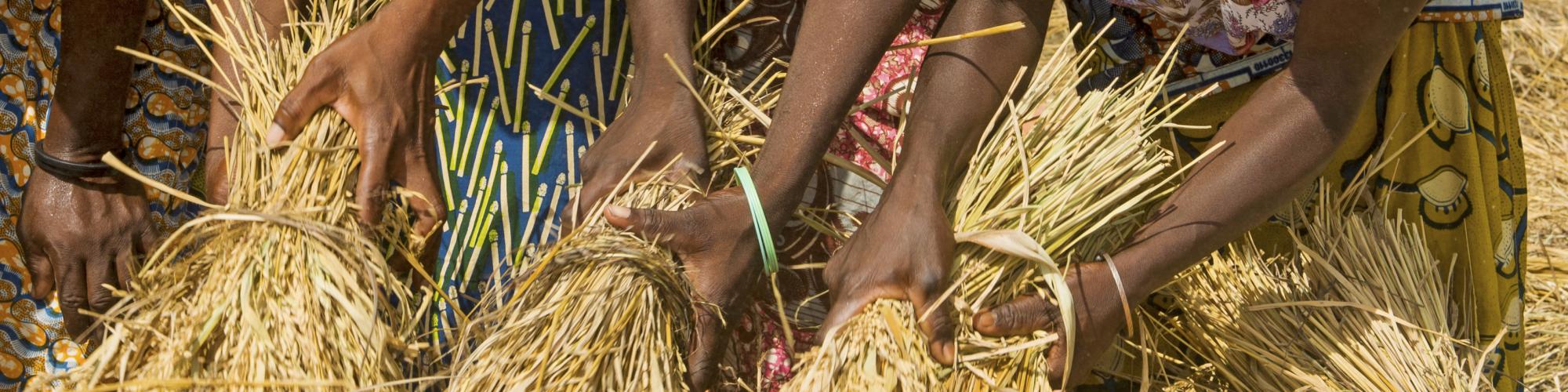
Product processing generates value. In Benin, Louvain Coopération is working on cassava processing systems. In a country where cassava is sold everywhere, quality must be emphasised in order to increase sales, which is why we are working on group marketing and quality control. The challenge is the same in Togo: "In the case of rice in Togo, we suffer from a poor image: in restaurants, people prefer Asian rice because it is Asian, and because the rice from the region can sometimes break your teeth due to stones, because the product has been poorly prepared. ‘ So we have set up rice parboiling units: ’This has enabled groups of women to increase their economic opportunities. It is also a priority: to give opportunities to those on the margins of the system (women, young people)."