Afro-Racines: creating spaces to reflect on Afro-descendant identity
Afro-Racines: creating spaces to reflect on Afro-descendant identity


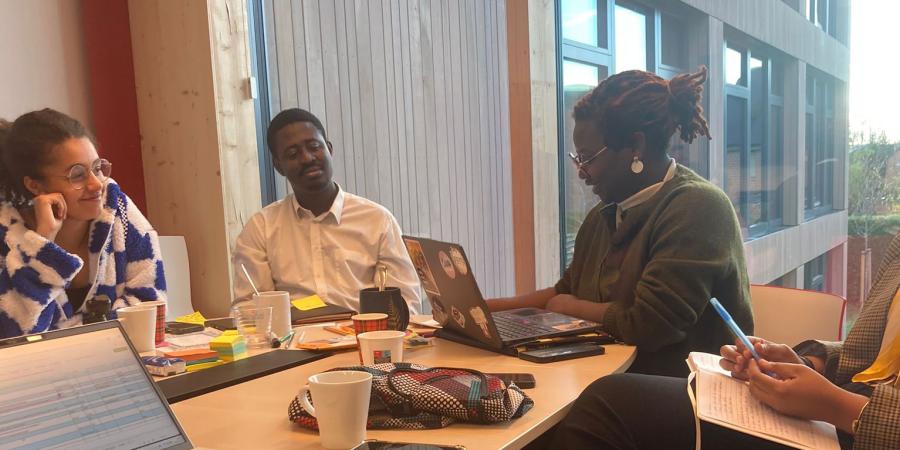
Nana Tounkara joined Louvain Coopération's Citizen Education team last September as Educational Coordination and Experimentation Manager, taking over one of the division's flagship projects: Afro-Racines*. As she prepares to leave for Benin with the participants, she reflects on the meaning of this training programme, her personal commitment and the issues it raises.
A natural continuation after Afro-Récits
Taking over Afro-Racines seemed like a natural continuation for me. As a person of African descent, I was part of the Africa United Kap collective, with which we co-created the Afro-Récits project in collaboration with Louvain Coopération. Afro-Racines is directly in line with this dynamic: creating spaces where young people of African descent can reflect on their history, their identity and their place in society.
I would like this initiative to be a long-term one. I hope that Afro-Racines will not remain a one-off project, but will become a real journey of reflection, transmission and commitment within Louvain Coopération.
Exploring a plural and legitimate identity
The Afro-Racines programme encourages deep reflection on identity, and more specifically on African-descendant identity in all its complexity. I see it as a space where young people can understand that their identity is plural, fluid and fully legitimate, without having to choose between different affiliations.
Through a series of encounters, the programme also promotes the development of essential skills: critical thinking, the ability to engage in dialogue, listening to different stories and putting sometimes difficult experiences into words. It is a space where we learn to question our heritage and silences, but also to imagine forms of engagement that can be rooted in both Africa and Europe.
Memorable exchanges around transmission
What has struck me most so far are the moments of spontaneous exchange around transmission. The young people began to talk about their relationship with their parents, unspoken family issues and the feeling of not having access to certain stories or knowledge.
These discussions created a real sense of solidarity within the group. Many realised that they were not alone in asking these questions. These are very powerful moments, where people speak with great sincerity.
Reconnecting with one's roots: very real challenges
One of the main challenges facing young people of African descent concerns identity itself, which is often torn between several worlds and rarely recognised or valued. Added to this is the question of returning to Africa, whether real or symbolic: should they return, how, why, and with what kind of commitment?
Intergenerational transmission also plays an important role. When certain knowledge or stories cannot be passed on within the family, young people find themselves on a real quest for meaning and guidance.
The trip to Benin: an exciting time ahead
As the departure date approaches, what excites me most are the upcoming meetings with other youth groups in Benin. The exchanges around visions of Africa, commitment, and sometimes even disagreements, seem extremely rich to me. It is often these confrontations of points of view that give rise to the most profound reflections.
I see this trip as an intense and transformative experience that is bound to leave a lasting impression on the young people.
My role: to accompany and support
During this journey and throughout the trip, my role will be primarily one of support. These are experiences that can be unsettling, moving and deeply thought-provoking. My goal is to be attentive to what the students are going through, to accompany them in whatever emotions may arise and to offer them a space to express their feelings without judgement.
What I want to convey to them is that it is legitimate to ask questions, to have doubts and to feel strong emotions. All of this is an integral part of the journey of identity and commitment.
*Afro-Racines is a training course dedicated to the issues, heritage and dynamics of the African diaspora, taken by students at UCLouvain. Designed as a space to discover, reflect and reconnect with Africa, Afro-Racines aims to strengthen young people's knowledge, capacity for action and civic engagement, in particular through a journey back to their roots in Benin.
More news