
Edito
Access to healthcare, a right to be defended
In the 1820s, Belgian workers established the first forms of mutual health insurance. Together, they organised themselves to provide financial support to their injured or sick colleagues and prevent their families from falling into poverty. Gradually, the state began to support this organised solidarity. But it was a long struggle. It was not until 1945 that health insurance was made compulsory for all Belgians, making the mutualist system truly viable.
This brief history reminds us that access to healthcare is a right that has been hard won in Belgium. Today, this right remains inaccessible to the vast majority of Africans (around 80%). There are health insurance systems, often linked to a profession or intended for civil servants in the formal sector. But for those who depend on the informal sector, such as farmers, saleswomen, craftswomen, etc., there is nothing.
Nothing. It means exorbitant healthcare costs, debt to pay bills, no support in the event of catastrophic medical expenses, leading families into extreme poverty and a fragile healthcare system due to lack of funding.
Solidarity is therefore organised, among other things, around community health mutuals, to which members contribute in order to access quality healthcare, thereby reducing the risk of debt in the event of illness. These mutuals are based on participatory management and risk pooling.
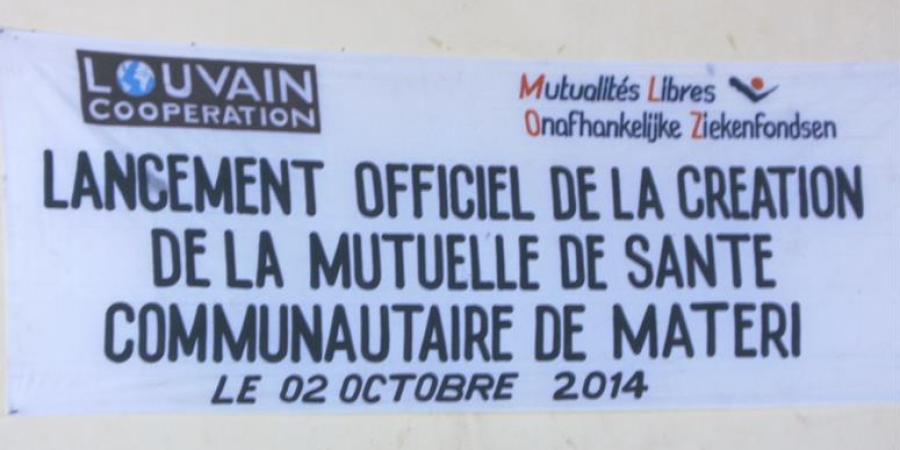
Every day, our teams, mutual insurance companies and their unions work tirelessly to keep this system alive, with the aim of expanding it and providing protection for the entire population. For 20 years, the Mutualités Libres have been working alongside us, putting their expertise at the service of this cause.
It is not just a matter of making healthcare affordable; together with our partners, we also work on prevention by informing communities about diseases and how to protect themselves against them.
The fight for access to healthcare is a long one, but it is absolutely essential. After all, how can we improve our living conditions if a simple illness can destroy everything? Education, sustainable agriculture and food, entrepreneurship... Without health, our other battles lose their meaning.
Brice Titipo,
Head of Access to Healthcare Programme
& Health Promotion in West Africa
In 2006, the National Union of Free Mutual Societies and Louvain Coopération laid the foundation for a partnership focused on access to healthcare. First in Benin, then in Togo and Burundi, the two organisations collaborated in many ways to develop the mutualist movement in these countries. Twenty years later, Christian Horemans, International Affairs Expert for the Mutualités Libres, looks back on this collaboration.
LC : Why, 20 years ago, did MLs wish to invest in the development of mutual health organisations in Africa?
CH : We regularly received requests for support for projects, particularly in Africa. It wasn't part of our plans at the time, but we found it interesting. We needed a high-quality partner, so we started contacting various organisations to learn more about the sector. We were then recommended Louvain Coopération, which was working on mutual societies. It was the first time we had set up a project like this and, for us, the underlying objective was international mutual solidarity and the exchange of expertise and knowledge.
LC : Do your motivations from back then still make sense today?
CH : Yes, achieving structured access to healthcare in countries where 80 to 90 per cent of people live in the informal economy and therefore have no health coverage remains a very big challenge, a truly relevant challenge. There are many stories of families who have been financially destabilised by healthcare costs, and some of them have had a particular impact on me.
In northern Benin, between 2023 and 2025, we carried out a large-scale project for the prevention and screening of breast and cervical cancer, initiated by the Mutualités Libres and funded by Wallonie-Bruxelles International. Largely unknown to a large part of the population, these diseases are currently wreaking havoc on the African continent. According to the WHO, 70,000 deaths from cervical cancer could be prevented each year in Africa through early screening, treatment and prevention through vaccination.
"Through this project, we organised training courses for healthcare workers on screening for these cancers. These were refresher courses to enable them to fully understand these diseases and what they involve. Learning to recognise them and treat them, depending on their stage of development," explains Pascaline Tiamou N'koué, a midwife in Tanguiéta, a town in north-eastern Benin.
In a context where healthcare systems are fragile, access to information and preventive measures are essential. By relaying health messages and facilitating screening campaigns, mutual health organisations are establishing themselves as key players in the fight against disease.
Ignorance has always been one of the greatest enemies of health. How can we be wary of and protect ourselves from a disease we know nothing about? Very recently, the first weeks of the Covid-19 epidemic tragically reminded us how vulnerable we are to an unknown virus.
To overcome ignorance about health, two elements are essential: scientific research, to understand and treat a condition, and the dissemination or communication of this new knowledge to as many people as possible. For the latter, mutual health organisations are an invaluable asset thanks to their community roots and the expertise they have developed in disseminating information.
In sub-Saharan Africa, a health problem can still plunge an entire family into poverty. Without adequate social protection, households finance their own healthcare, often at great sacrifice. Given this reality, mutual health organisations, and more specifically community-based mutual health organisations, are an essential lever for ensuring sustainable and equitable access to healthcare. However, they must be given the means to fully play their role.
Today, less than 20% of the African population has access to health-related social protection. And in sub-Saharan Africa, 94% of the poorest and 97% of those living in extreme poverty are not covered or are inadequately covered (World Bank, 2025). A very large proportion of healthcare financing is therefore borne directly by households, exposing them to a significant risk of poverty.
Behind these figures are human beings and everyday realities that are unimaginable to Westerners: a father who hastily sells part of his harvest to pay for medicine to cure his son, knowing full well that there will not be enough food for the rest of the family. Or an expectant mother in labour praying that her family will raise the money needed for the caesarean section that will save her and her child.
Every year, several students from UCLouvain complete their dissertation or end-of-study internship in collaboration with Louvain Coopération. They travel to the regions where we work and conduct research related to our activities there.
Many students are involved with Louvain Coopération through internships, dissertations or voluntary work. Some of them are studying for a Master's degree specialising in Water-Energy-Food Nexus, co-organised by UCLouvain and ULiège, which aims to strengthen technical and integrated management skills in the fundamental resources of water, energy and food. ‘It is not at all easy to find internship placements for this type of subject,’ explains Professor Charles Bielders, who is responsible for this Master's programme at UCLouvain. "We therefore involved Louvain Coopération in our approach from the outset of the project, so that we could send students to the various countries where the NGO is active. This is a really great opportunity for students, both to work on the theme of water, energy and food, and to benefit from the environment and welcome offered by Louvain Coopération. It is also an opportunity for Louvain Coopération to introduce the concept of the EEA Nexus into its activities."
At the end of the various internships, a presentation day is organised to share the knowledge and research results with the academics present, but also among the students, so that everyone can benefit. Currently, the internship topics are not related to each other, but this could change, allowing students to build their research on the results of their predecessors and thus go even further in their research and the concrete impact it can have in the field.

Receive Devlop' No. 22
Find out more