“It is fundamental to offer them opportunities for the future”
“It is fundamental to offer them opportunities for the future”


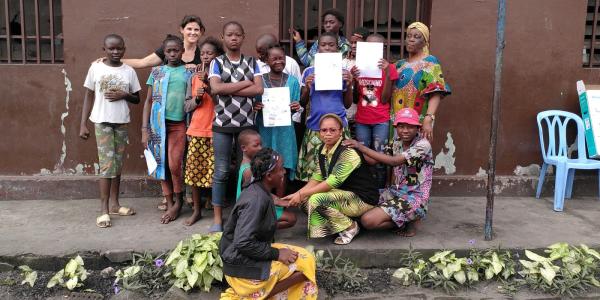
Alexandra Bataille, an educator specialising in working with young people in street situations, returned to study clinical psychology at the University of Paris. She did her Master's placement in Kinshasa, within our project, more specifically in the girls' reception centres. She talks to us about this experience.
LC : How would you describe the psychological state of the young people you met ?
These children have all, to a greater or lesser degree, experienced trauma. Most of them have been accused of being child witches and entrusted to churches that have often tortured them in order to exorcise them. Many were abused by their families, rejected and abandoned. They have spent time on the streets, where they have suffered numerous assaults and acts of violence. So when they arrive at the centres, they are very scarred by all that.
LC : How do you support them ?
The first thing is to welcome them and support them little by little in (re)building a positive self-image because the image they have is very devalued... We try to reduce their level of suffering so that they feel better about themselves and others and want to be part of a present and a future. This happens on an individual level, by working on their history and experiences, but also on a group level, by learning to live in a group, in society. On the streets, children have developed human relationships based on abuse and the use of force, and very early on they had to take responsibility for themselves in order to survive, so they have to (re)learn to be children. In the centres, the educational and psychosocial care provided aims to do just that to enable them to take their place. They can eat, sleep, play, go to school, be looked after... be children, in short.
This work also involves supporting socio-educational teams to reduce their stress and strengthen their skills, enabling them to offer care that is better tailored to the children's needs.
LC : Socio-professional integration also plays an important role in the psychological reconstruction of these children ?
Clearly. It's fundamental, in fact, because some of these children have no solution. They don't want to or can't go back to their families because they've been abused or thrown out and they don't want to go back to the streets. So they need another option. I think it would also be useful to develop specific centres for older young people who are in training, to support them until they have their own home, their own wages... It's vital to support them in their transition to a new life. It's vital to support them in this project, otherwise the upstream work risks coming to nothing. Psychosocial care loses its meaning without an integration project that offers a possibility for the future. Whereas if they are trained, it's a chance for real and lasting reintegration.
LC : How is the overall problem of street children in Kinshasa evolving today ?
Overall, the situation of street children is getting worse. In other words, there are more and more children on the street. It's empirical, because there hasn't been a census for 15 years, but all the associations agree that the phenomenon is increasing. Nevertheless, I think that for some of these children, going through the reception centres, working with their families and getting them back into society are really effective. These children also go to school and have a childhood. So I think these centres and these projects are really useful. But the task is monumental. It's a drop in the ocean, but a drop of drinking water.
More news