Edito
Empowering young people to bring about real change
Today, the younger generations are rising up for climate justice # ClimateJustice, gender equality #MeToo, migration justice #NotInMyName and anti-racism #BlackLivesMatter, the rise of nationalism in Belgium and the global North, ultra-liberalism and gender discrimination continue to grow (CNCD-11.11.11). These facts fuel the collective imagination of citizens, sow fear and reinforce stereotypes. At the same time, within this same generation, other movements are flourishing that are openly nationalist, racist, homophobic and sexist. Added to this, the development model in the global North, once praised for its efficiency and wealth creation, is increasingly showing its limitations through socio-ecological crises that lead to inequality and the destruction of our planet.
Higher education is not immune to this dysfunction. For example, the increase in tuition fees for foreign students (RTBF), the harassment and sexual assaults that are increasingly coming to light (UCLouvain), the whiteness of the academic body, etc. illustrate these inequalities at the structural level and at the level of Eurocentric epistemologies, thus producing effects of blindness and ignorance.
Through its North programme, Education for Global and Solidarity Citizenship and Continuing Education, Louvain Coopération's mission is to further promote critical thinking around these power relations within the university community, higher education institutions and art schools, and in particular among the student population. Encouraging this critical thinking requires understanding inequalities, which are often cumulative, as a set of inequalities that feed off each other and reinforce each other: ‘they form a system’ (Raymond Boudon and François Bourricaud). By social inequalities, we mean inequalities of resources, gender, knowledge and power. These inequalities dominate our relationships, both in the Global South and in the Global North, and even more so in the relationships between the two. Our programme therefore aims to contribute to the emergence of a whole movement that analyses this system of domination without essentialising it, in order to better deconstruct it, but also to reinvent it, to propose courses of action to students and to support them in the process of change. This movement aims to be both reflective – in contact with the academic world – and action-oriented – together with civil society actors.
Fiona Nziza,
Northern Programme Manager
Co-constructed with a collective of students from UCLouvain, Afrika United Kap, the Afro-Récits project looks at the invisibility of racial discrimination in society and at university in particular. It aims to support Afro-descendant student collectives in building opportunities for structural change towards a more egalitarian society.
The project entitled: ‘Afro-Récits: S'émanciper pour lutter contre les discriminations raciales ’, stems from various exchanges with students from African diasporas studying at UCLouvain and from the ‘ Décolonisation’ working group at UCLouvain, whose remit was to draw up a report on the role of the university in decolonisation. It also draws on the conclusions of the interdisciplinary colloquium organised by the NGO Avocats Sans Frontières and MIT, in which Louvain Coopération took part, bringing together African diasporas living on the continent. Finally, it was built around discussions with the organisation ITECO, which aims to put citizens back in the driving seat of society, and with whom we continued the reflections.
One of the major issues identified by these various players is the invisibility of racial discrimination in society and at university in particular. Afro-descendant students also said they needed tools to help them think about themselves, put words to this discrimination and develop the ability to take action by speaking out for themselves, with a view to emancipating themselves and raising awareness among their peers.
.
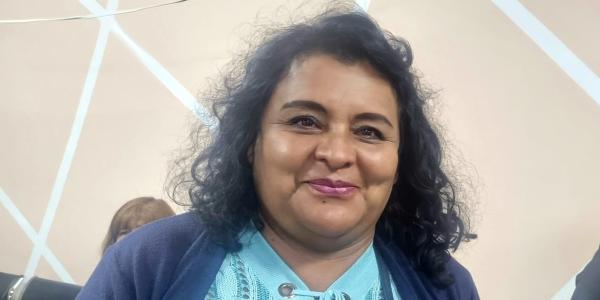
In February this year, Carmelle Nezerwe, an anthropologist by training with a specialisation in international humanitarian action, joined our ECMS team, alongside Fiona Nziza and Juliette Delvaux. She will be sharing her time between Louvain Coopération and AMO La Chaloupe (see opposite), in order to increase collaboration between our two organisations. ‘What motivates me to work in Global and Solidarity Citizenship Education is the creation of spaces for exchange, reflection and co-construction of knowledge with the aim of moving towards collective and individual civic engagement ’ she explains.
"I believe that the ECMS has the strength to confront our convictions, to push us to decentre ourselves and to drive a change in both individual and collective behaviour. This collective impetus generates a societal impact that aims to influence political decisions, among other things.
Furthermore, the themes put forward by Louvain Coopération and La Chaloupe, i.e. ecology, feminism, decolonisation and their variations, are a source of motivation for me. I'm convinced of their importance and I want to stimulate everyone's experience of otherness, so that we can meet and recognise others and their identities. Working with young people in Belgium and Benin on these subjects will certainly be a challenge and a very interesting experience in terms of the cross-fertilisation of knowledge and practices.
She adds: "It is very important to involve young people in societal issues, to make them aware of the importance of these. This will give them the tools they need to take action at their own level. In a world focused on growth at all costs, it's vital to motivate young people to get involved in order to achieve a paradigm shift. "
In collaboration with Enabel's Be global programme, Uni4coop is organising a training module for agrégation students. We are looking at issues of inequality and discrimination and how the school environment can both reproduce and combat them. We are inviting students to consider their positions as (future) teachers and their roles in shaping new generations of citizens. In the light of an education that fosters critical thinking and openness to the world and to others, tomorrow's generations will be able to work towards a fairer and more equitable world.
Louvain Coopération is recognised by the Wallonia-Brussels Federation as a continuing education association. This means that we encourage and develop young adults' awareness and critical knowledge of the realities of society. We also strive to instil in them the ability to analyse, make choices, take action and evaluate, so as to foster attitudes of responsibility and active participation in social, economic, cultural and political life.
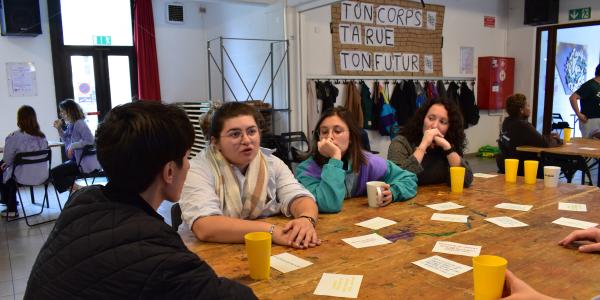
In this context, we have developed various projects, such as the work we have done with the residents of the Centre Placet (a hostel for UCLouvain students from countries supported by the Belgian Development Cooperation) on the issue of (de)colonisation, which has led to the joint organisation of a series of lectures.
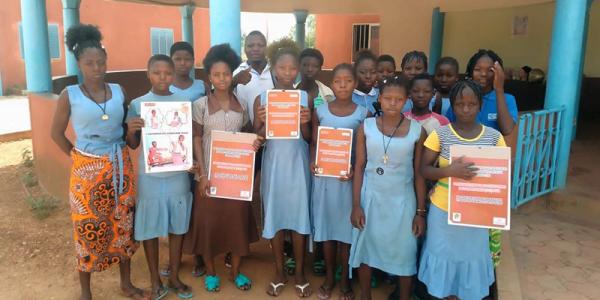
We are also working with La Chaloupe, a youth support organisation in Ottignies, with whom we have decided to form a partnership to bring our audiences together and encourage exchanges between young people in the South and North on the issue of interculturality, particularly in Benin.
Why did Belgian farmers take to the streets en masse last January? How do our eating habits have a major impact on the lives of farmers on the other side of the world? We tackle these questions at our annual Uni4Coop activity: ‘DJESA’, or Half-Day Exchanges on Food Sovereignty.
In collaboration with Vétérinaires Sans Frontières and Humundi, this year we had the opportunity to organise the ‘DJESA’ activity for all the Bac 2 bioengineering students at UCLouvain. It provides a fresh, cross-disciplinary look at food sovereignty issues in Belgium and internationally. The aim is to provide a space for reflection and debate on the major societal issues linked to changes in our food systems.
To introduce the debate, Brigitte Grisar and Jacques Esnault's ‘Faim de vie’ (Hungry for Life), a combination of theatre and lecture, asks: ‘How can thousands of people in 21st century Belgium not get enough to eat? How, throughout the world, is humanitarian food aid still a reality? But if hunger is not an inescapable reality, who is responsible for it? What can we do to change this state of affairs?
The students are then divided into in-depth thematic workshops, combining participative facilitation techniques with the expertise of our guests. Faced with the social and environmental challenges posed by the dominant agricultural model, the Sytra (Centre de recherche et études stratégiques sur les systèmes agroalimentaires) research team presented the various agricultural alternatives for the 21st century. FIAN, an international organisation that fights for the right to adequate food and nutrition for all, addressed the issue of access to land, a challenge for farmers around the world, but also ways of taking action at political and citizen level. Lastly, the NGO Humundi examined the problems associated with the globalisation of agricultural trade through two illustrative cases: Wallonia's dependence on international trade and the impact of European exports on the incomes of livestock farmers in West Africa.
Depuis le mois de février, un tout nouvel escape game s’est installé à Louvain-la-Neuve. L’objectif ? Résoudre les énigmes disséminées dans Louvain-la-Neuve en un temps limité pour percer le secret d’une horloge maudite. Louvain Coopération, la Maison du Développement Durable (MDD) et l’UCLouvain ont uni leurs forces pour mettre sur pied ce projet qui, de manière ludique, nous permet de nous pencher sur les grands enjeux de notre planète.
« Chers confrères, un objet maudit m’est parvenu, bien malgré moi. À première vue, il ne s’agissait que d’une simple pendule. Et pourtant, elle dissimule des secrets que je ne soupçonnais pas. En essayant de la remettre en route, j’ai découvert que d’autres scientifiques s’étaient penchés sur son cas, et sont tous tombés sur le terrible secret de l’horloge. Je vous écris pour vous demander et vous enjoindre de toutes mes forces de ne pas ouvrir cet artefact dangereux. Ce qu’il montre est insupportable et je l’ai scellé à tout jamais. Le destin de l’humanité restera secret pour toujours. »
C’est par cette missive datée de juillet 1965 que Georges Lemaître pose les jalons de votre partie. En équipe de 6 à 12 joueurs, vous disposerez de 60 minutes pour percer le secret de la Pendule de Vitruve. Vos méninges, vos jambes et votre connaissance de la cité néolouvaniste vous seront bien utiles pour résoudre les nombreuses énigmes qui vous seront soumises !
The activities carried out by Louvain Coopération in Belgium are many and varied. Organised throughout the academic year, they aim to raise awareness in the academic world, particularly among students, of South/North imbalances, gender inequalities and environmental problems.
As a university NGO, Louvain Coopération has a fundamental mission: to equip the adults of tomorrow, our students, to understand the major issues facing our world. From ecology to feminism, via decolonisation and, more generally, North/South relations of domination, our ECMS team is multiplying activities to question, with young people, the different facets and systems that lie behind the major discriminations of our time.
These activities can be integrated into a course or offered freely to students. They take the form of conferences - debates, exhibitions, plays or training weekends and are organised on the Louvain-la-Neuve and Woluwe campuses.
Education for global citizenship is a holistic education that opens people's eyes to the realities of the world and encourages them to work for greater justice, equity and rights for all.
Maastricht Declaration 2002
Receive
the full version
of the Devlop' newsletter
News / Videos - Find out more...