
Natural resources

Picto
Ressources Naturelles

n°1 Devlop RA

Contenu
Image 4:1
Réinventer demain
Contenu
Texte

DevlopRA

Dossier

Contenu
Texte

Edito

Impact Chronicles

Spring is always a special time at Louvain Coopération. It is a time to take stock of all the actions carried out during the previous year and to present our Activity Report. This raises some difficult choices: what to include? What to choose from the multitude of things we have accomplished? Which results to highlight? How can we best illustrate our impact and the changes it brings about in the populations and communities with which we work?

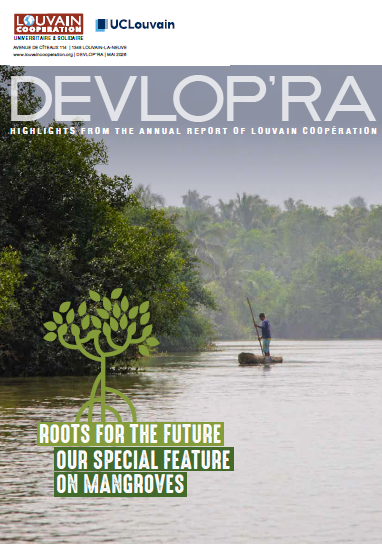
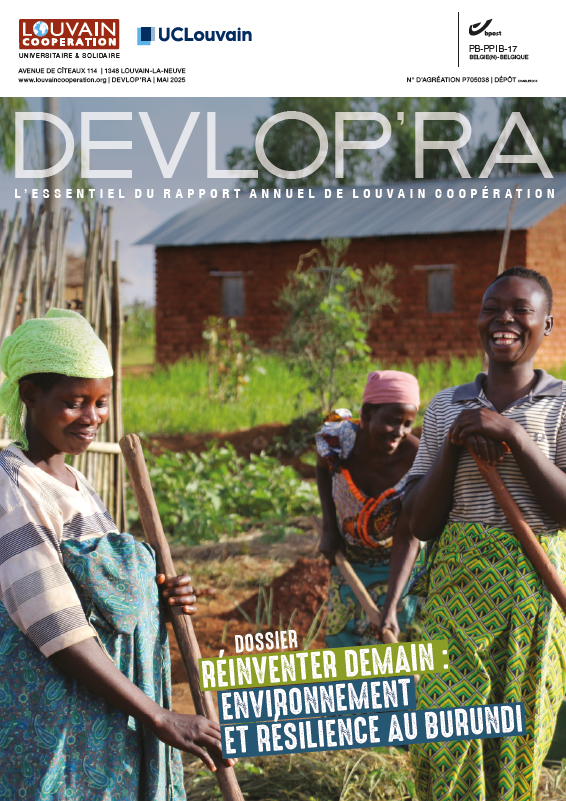
This year, we wanted to embrace change and present our ‘AR’ in a completely different way. It comes in the form of a Devlop'RA. This special edition features our annual results, presented according to the systemic approach and specific methodology of Louvain Coopération, which we have defined in order to better respond to today's global, complex and interconnected challenges. Our goal is to act on four systems – agriculture and food, health, entrepreneurship and education – and their interactions in order to strengthen the resilience of change agents and develop cross-cutting, coherent and sustainable responses. We also wanted to take advantage of this Devlop'RA to continue talking to you about the heart of our work. So we are heading to Burundi, where environmental challenges are compounded by the need to produce enough food to meet the needs of a growing population.

A dual objective, therefore: to present our overall impact and offer more content.

As with any change, doubts arise. How will this new format be received? We sincerely hope that yours will be warm. In any case, we are always open to your feedback.

We hope you enjoy reading this issue and thank you from the bottom of our hearts, because the projects featured in this first Devlop'RA exist thanks to your support.

Emilie Stainier
Communications Officer

Block
Contenu
Texte

Devlop'RA N°1

Texte

Recevoir le Devlop'RA

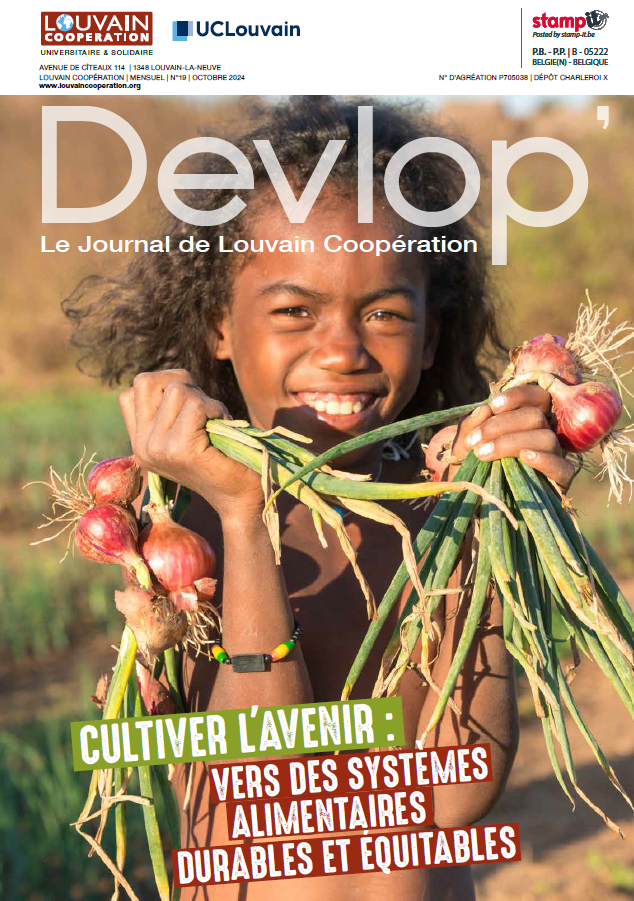
Journal 19 - Cultivating the Future

Contenu
Image 4:1
Cultiver l'avenir
Contenu
Texte

cultiver l'avenir: vers des systemes alimentaires duravles et équitables

Contenu
Texte

Edito

Complementary and interconnected solutions for sustainable change

Today, the challenges posed by climate change vary considerably between countries in the North and those in the global South, due to economic, social and environmental differences. Solutions exist to make vulnerable populations, mainly living in the Global South, more resilient. This requires a systemic and inclusive approach that builds local capacity and supports sustainable agricultural practices, while preserving the environment for future generations.

Sustainable food systems aim to address these issues by providing healthy food while respecting the ecological limits of our planet. To strengthen the resilience of agricultural producers, it is now imperative to promote agroecological practices that favour production systems that are both productive and sustainable. Agroecology promotes biodiversity, improves soil health, reduces the use of pesticides and chemical fertilisers, and supports local knowledge and practices. It integrates social and economic aspects by seeking to strengthen the autonomy of family farms.

By adopting sustainable agricultural practices, managing natural resources efficiently, strengthening local value chains and promoting social justice, it is possible to create food systems that feed the world's population while preserving the environment and promoting economic and social equity. International collaboration, technological innovation and the engagement of local communities are essential to successfully transitioning to sustainable food systems.

There is an urgent need to build a more resilient, equitable and environmentally friendly future. Our teams and partners are working tirelessly to achieve this ideal. In this endeavour, sustainable food systems, agricultural value chains and agroecology are our greatest allies: complementary and interconnected solutions to drive change.

Doriane Desclée
Sustainable Food Systems Theme Lead

Block
Contenu
Texte

Cultiver l'avenir

Texte

Recevoir le journal complet

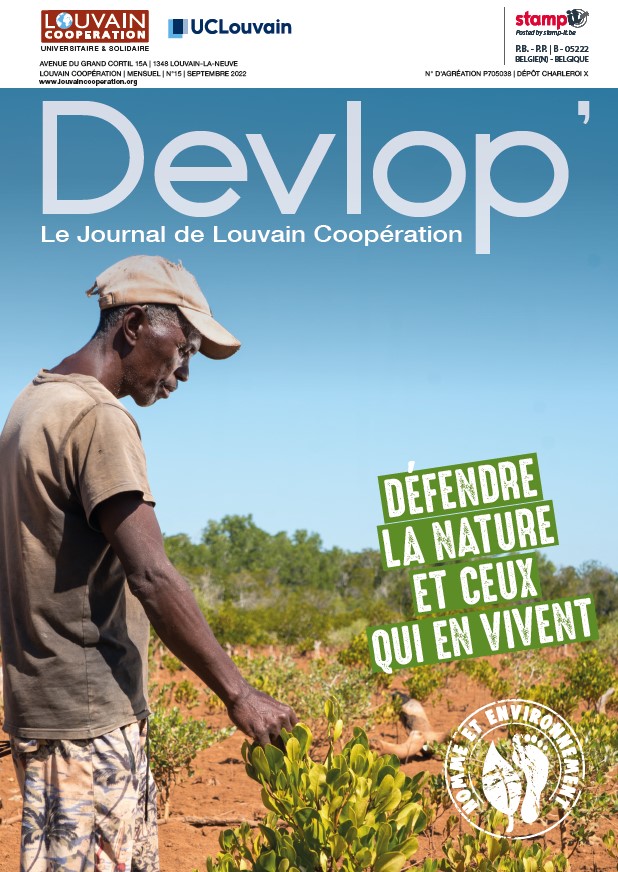
Defending nature and those who live off it

Contenu
Image 4:1
Journal Devlop' 15 - défendre la nature et ceux quei en vivent
Contenu
Texte

Edito

Safeguarding the environment and human activities

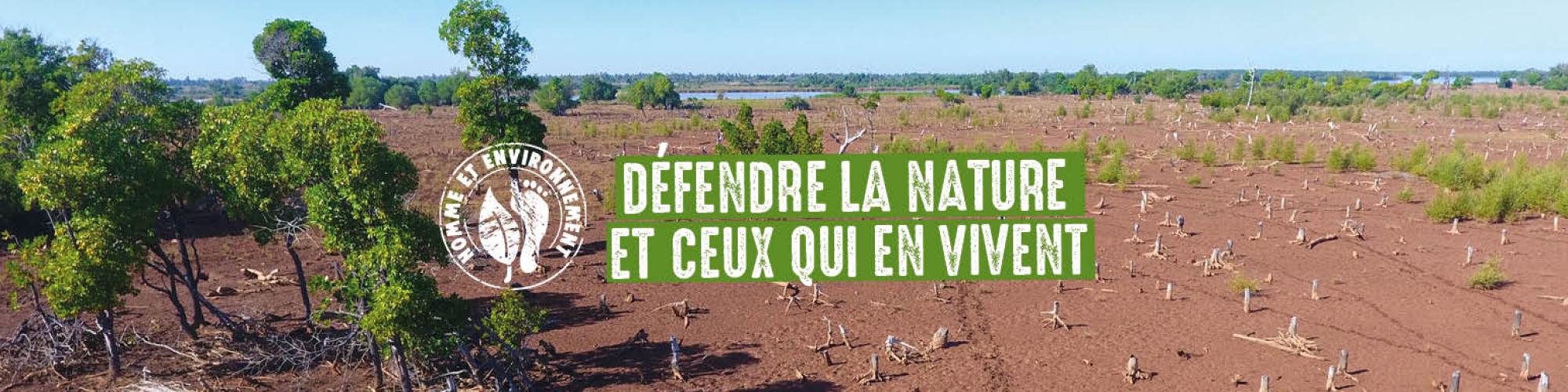
Environmental issues are now becoming increasingly important in development projects. This is not a choice, but a necessity, an obligation, an urgent matter. Even more so than here, the impacts of climate change are disrupting daily life, particularly for people in the Global South. Farmers, fishermen, herders... all these men and women who depend on nature for their livelihoods are watching it rebel with a sense of helplessness and concern.

Much of the work to be done lies with us, in revolutionising our habits. If we want to take action elsewhere, then we must do so properly. It is not a question of imposing our vision of environmental conservation on the Global South. It is essential that we work with our partners and the communities concerned to understand their needs and develop sensible and effective actions.

Can a person's life be measured in hectares of forest? In the number of rare animal and plant species? We refuse to make that choice. The only possible path for us is to seek a balance between protecting the environment and human activities, between conserving natural resources and ensuring dignity for those who depend on them.

In this challenge, we can count on the expertise of our local partners, UCLouvain and local universities. These invaluable allies enable us to constantly challenge, rethink and innovate in our actions and in the quest for a fairer and more sustainable world.

Block
Texte


Receive
the full version
of the Devlop' newsletter

Contenu
Texte

News / Videos - Find out more...

Contenu
Texte

Journal Devlop' 15 : homme et environnement

Texte

Receive the full newspaper