At the heart of helping street children rebuild their lives
At the heart of helping street children rebuild their lives


How can a child be helped to rebuild their life and grow when they have experienced the worst? This question is on the minds of the teams supporting street children and young people in Kinshasa every day.
For several years now, Louvain Coopération has been developing a psychosocial approach based on a holistic approach to supporting young people. This support is essential to enable them to rebuild their lives and look to the future. The organisation is supported in this endeavour by the non-profit organisation Terres Rouges.
“The psychosocial aspect of the work carried out within care institutions is essential. These young people have experienced trauma, violence, and both economic and sexual exploitation. Therefore, if no work is done to help them recover psychologically, they cannot envisage a future for themselves.” For the past seventeen years, Hermann Hessou and Eric Messens, directors of the Benin and Belgian branches respectively of the non-profit organisation Terres Rouges, have held this conviction. This conviction has enabled them to develop specialist expertise in this field, which they strive to share.
Today, many care centres, in Kinshasa and elsewhere, wish to set up psychosocial support programmes, but they are not always well equipped to carry them out effectively. “The psychosocial approach is in-depth work, built step by step as a relationship of trust develops. It requires those working with the child to be professionally equipped”, explain the specialists.
Tools that help to avoid the many pitfalls along the support journey: “Children who are cast aside, punished, forgotten, or pigeonholed into categories (the lazy ones, the thieves, the liars…). Our job is to free them from these social categories by taking a case-by-case approach, which requires strong teams where we all work together.”
Building partnerships with institutions
Louvain Coopération and other organisations working with young people in Kinshasa have, alongside Terres Rouges and with the support of the King Baudouin Foundation, launched a ‘Learning Journey’. It aims to work together, drawing on the experience of those on the ground (street educators, psychologists, etc.), to develop effective tools and methods tailored to the local context.
One of the objectives is to break down the silos in psychosocial work, which is all too often the sole preserve of psychologists. “Children living in an institution will develop relationships with the various members of a team. From the cook to the nurse, via the caretaker, everyone has a role to play. As they have experienced extreme hardship, young people may prefer to confide their deep pain to the cook rather than go and see a psychologist”, explains Hermann. “We have therefore developed a model in which psychosocial work is the responsibility of everyone working within the institution. The ideal tool for bringing together what the child has shared is the team meeting, which brings everyone together. Subsequently, more in-depth work can be undertaken with mental health professionals.”
Following this learning process, the centres have introduced these team meetings, as well as other changes that significantly improve day-to-day work and, consequently, the care provided to children. Examples include greater collaboration between management and teams, and synergies developed between the various institutions, notably through a monthly meeting of psychologists from each centre.
On a day-to-day basis, this approach helps to reduce gaps in care, strengthen the young people’s sense of security and improve their chances of reintegration into family life, school or the workplace.
A guide to best practice
All the work carried out over these two years has resulted in a guide, published by Terres Rouges, which sets out 12 best practices to be implemented for high-quality psychosocial support. “This tool serves as a benchmark, providing guidelines that can be discussed and adapted within teams. And it is obviously not limited to Kinshasa: it could also be used in Belgium, within institutions,” explains Eric.
More than just a collection of principles and tools, this guide aims above all to improve the quality of support offered to children. By strengthening teams’ practices, it helps to create the conditions necessary for young people who have experienced trauma to regain confidence, rebuild relationships and look to the future once more.
Today, to support these young people, Louvain Coopération needs to raise funds.
You can help them do this. Thank you from the bottom of our hearts.
Find out more about this topic
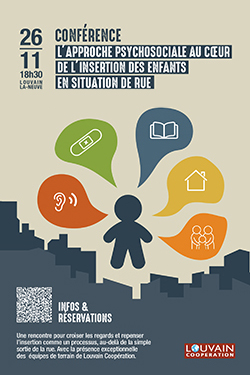 On Thursday 26 November, in Louvain-la-Neuve, come and join the discussion on psychosocial support for children and young people living on the streets. This conference will bring together practitioners and experts: a psychologist who is the project coordinator for Louvain Coopération, two experts from Terres Rouges Bénin, and Professor Isabelle Roskam (UCLouvain).
A rare opportunity to meet the people who support these young people on a daily basis, and to understand how your contribution to the 1+1 campaign makes a real difference.
More news