Mangroves: local communities on the front line
Mangroves: local communities on the front line


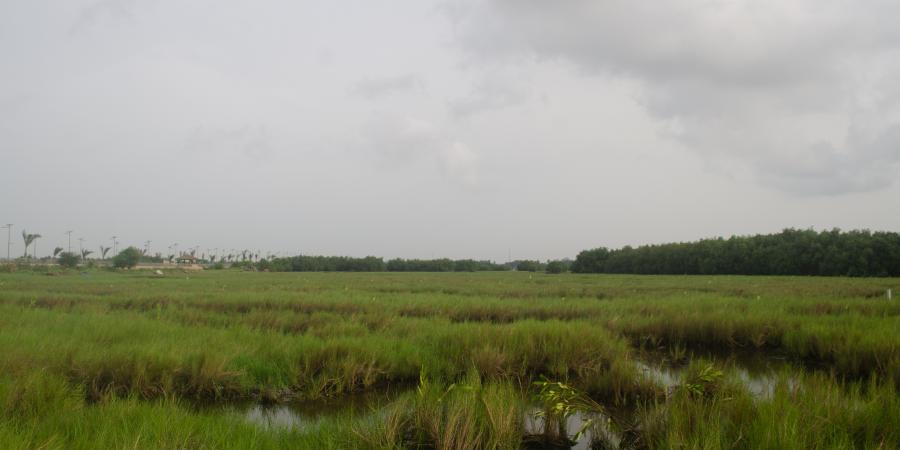
In southern Benin, mangroves have lost a quarter of their area in the space of a few decades. With the support of Louvain Coopération and its partners, local communities are now working to restore them, develop sustainable alternatives and revitalise fishery resources.
Benin’s two main mangrove forests are situated in the Atlantic and Mono departments. These areas are particularly vulnerable: it is estimated that deforestation and climate change led to the loss of 25 % of Benin’s mangroves between 1980 and 2006, with direct consequences for fishing activities. Since the 2000s, growing awareness seems to have slowed this destruction. In collaboration with our partners, Action Plus and Eco-Bénin, and local stakeholders, we are part of this effort, working to restore these forests and establish economic and income-generating activities that ensure their long-term sustainability.
Sustainable salt
For many years, women living in mangrove areas have developed specialised expertise in salt production, which is obtained by evaporating seawater. This activity provides a source of income for families, but it requires firewood and therefore leads to deforestation.
In collaboration with the National Higher Institute of Industrial Technology (INSTI) in Lokossa, we have been working on alternative energy solutions. “ They collected technical data on salt production and the types of stoves used, carried out an in-depth review of studies on the subject and assessed energy demand. A more energy-efficient salt production model was designed and trialled in 2025. This involves solar salt, obtained by evaporating seawater on a tarpaulin spread out in the sun ”, explains Richard Ayelesso, technical assistant at Louvain Coopération in Benin. Today, our challenge is to convince salt producers to switch to this method of production, in particular by providing suitable equipment and raising their awareness of the impacts of climate change. It should be noted that INSTI is also working on the development of eco-friendly charcoal (made from paspalum and typha) and stoves adapted for use with this charcoal.
Bringing the fish back
Another issue facing these areas is the sharp decline in fish catches, even though the majority of families depend on fishing for their livelihood. In 2023, we supported local communities in creating drainage networks at two mangrove restoration sites on the shores of Lake Ahémé. “These channels facilitate plant growth and the dispersal of mangrove seeds, and act as a physical barrier against bushfires and cattle transhumance,” explains Richard. “& nbsp;Furthermore, they serve as a breeding and nursery area for fish stocks and encourage the recolonisation of fish, thereby improving fishing yields. ” The fishermen’s accounts are consistent : “ We haven’t returned to the catches of our ancestors, but the nets are coming up fuller. ”
More news