Madagascar: preserving mangroves to save small-scale fishing
Madagascar: preserving mangroves to save small-scale fishing


In Madagascar, mangroves play a vital role for biodiversity, fisheries and coastal communities. But in the Menabe region, this ecosystem is under threat from human activity and climate change. Together with its partners, Louvain Coopération is working with local communities to gain a better understanding of the overexploitation of marine resources and to develop sustainable alternatives.
Madagascar is particularly rich in mangroves: 310,000 hectares of the island are covered by them, 25,000 of which are located in the Menabe region, Louvain Coopération’s area of operation in the south-west of the country. But this wealth is dwindling: since the mid-1990s, 25 per cent of Madagascar’s mangroves have disappeared.
In Menabe, 500 hectares are lost every year. Repeated droughts have caused large-scale migration to the coast, exacerbating an already significant population pressure. Mangrove forests there are being cleared to make way for crops (rice paddies, sugar cane, etc.) and to harvest timber for heating or construction.
Direct consequences for fisheries
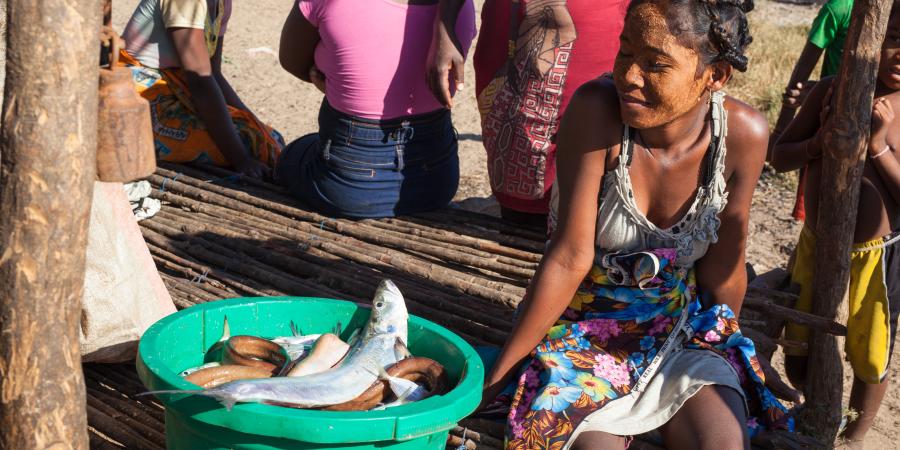
The destruction of mangroves inevitably has consequences for fish stocks and, consequently, for fisheries. Since 2024, Louvain Coopération has been working with the Institute of Fisheries and Marine Sciences and the consultancy firm Magnirike to analyse and understand the use of these resources, with a view to ensuring the sustainability of both mangroves and small-scale fisheries. “Initially, we drew up a monitoring plan and selected five representative villages, where we set up fisheries monitoring”, explains Franceline Rasoanirina, a research officer at Magnirike, who supervised the fieldwork carried out by the researchers. “This monitoring was organised on a participatory basis, involving a survey of fishing catches and interviews with households to better understand their needs and incomes.” In total, 172 fishermen responded and nearly 4,000 catch surveys were carried out.
The compiled results of these various surveys highlighted extreme overfishing in certain villages. “Poverty drives this overfishing,” Franceline explains further. “The communities cannot afford to give up fishing; the fishermen have no other means of livelihood…”
Alternative livelihoods
The next phase of this project involves presenting the results of the various analyses to the communities and working with them to identify solutions. One of the avenues being explored is the development of alternative income-generating activities, such as beekeeping or short-cycle livestock farming, in order to reduce the pressure on marine resources. “We have planned a trial phase for these economic activities, followed by close monitoring of them.”
More news