

No. 1 Caring to survive
Edito
There is something rather dizzying about writing the editorial for a magazine that did not even exist a few months ago. The dizziness of giving shape to a conviction that had, in fact, existed for a long time and was simply seeking to find its place.
A conviction that has developed gradually, over several years of working with young people and focusing on their ability to make a difference in the world, as part of global citizenship education within the university-based NGO Louvain Coopération. These years have transformed my practices and gradually led to a broader reflection on how, as an organisation, we produce and transmit knowledge, on the roles we assign to those who possess it, and on the stance from which we choose to act. This reflection has, in turn, led Louvain Coopération to shift its approach: to make more room for the knowledge and voices stemming from the experiences of those with whom it works, to learn from this knowledge, and to see itself as much as an organisation dedicated to listening and fostering connections as one focused on knowledge transfer.
Gradually, our practices have also evolved: producing as much as sharing, opening up more spaces for reflection and creativity, circulating knowledge without confining it to a ‘North’ or a ‘South’, breaking down barriers between approaches, and giving depth to issues that our usual formats sometimes only allow us to touch upon. This is how this shift in perspective has gradually taken hold within the institution. Louvain Coopération has chosen to make this a core aspect of its work, to give it a genuine place and to champion it collectively. From this movement, a new department was born: ALL, the Agency and Learning Lab, situated at the intersection of worlds that cross paths without always truly meeting – the academic, activist, voluntary and artistic spheres.
ALL was born out of this desire to shift the boundaries separating spaces that produce knowledge, experiences and creations, but which sometimes struggle to break free from their own codes, hierarchies and constraints.
ALL is not intended to remain a single location. What is explored, experimented with and created here should be able to circulate, so as to make room for forms of knowledge that all too often remain on the margins, to learn from those who embody them, and to make listening not merely a preliminary step to transmission, but a fundamental approach that shapes our action. We have brought these forms together under a single umbrella: C·ALL, the contributions of ALL.
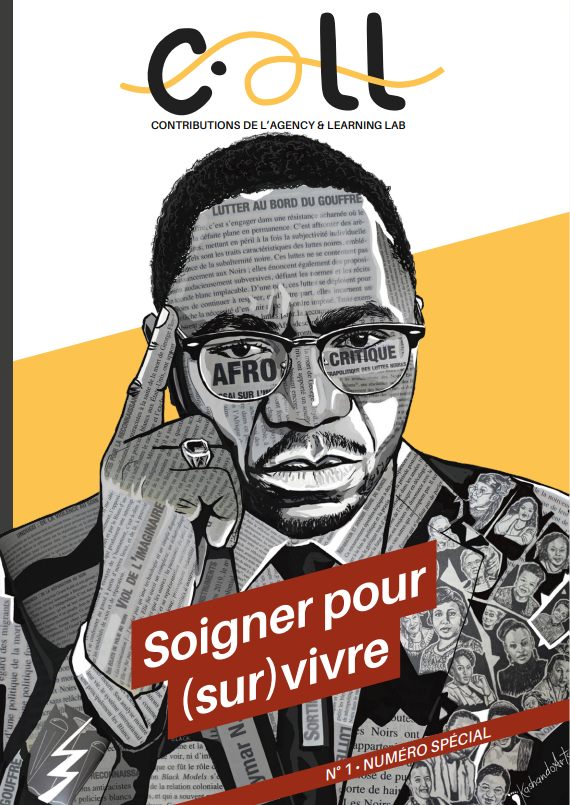
C·ALL – the journal , the first issue of which you are opening today, aims to inhabit this in-between space. To allow knowledge, experiences and practices to meet, engage with one another, and sometimes clash. And to see what this friction makes possible. C·ALL is also, quite literally, a call. A call to circulate experiences, concepts, narratives and creations. Not to separate too hastily what is thought from what is lived, what is analysed from what is felt, what is sought from what is created. The challenge lies in the conditions we create – or fail to create – for listening.
Perhaps this is where the ambition of the C·ALL Journal lies: to create a space where an experience can generate knowledge without ceasing to be an experience. Where creation is not merely an illustration of thought. Where research accepts being shifted by what it encounters. Where different forms of knowledge can engage with one another without any one of them having the power, from the outset, to define the others.
This first issue will find every reader wherever they are: in recognition, in questioning, in discomfort. Perhaps in all three at once.
The shaking of certain certainties is not a threat; perhaps this is where it all begins.
Enjoy the read.
Fiona Nziza, on behalf of the ALL team – Louvain Responsible Cooperation at the Agency and Learning Lab
This study draws on Aymar N. Bisoka’s book, *Afrocritique*: an essay on the infrapolitics of Black struggles, and more specifically on the concept of ‘soin-undugu’ that he developed therein.
Drawing on reflections and discussions held during literary gatherings with people of African descent in Belgium, it examines how this form of care – conceived as a collective relational practice of reparation and creation – can become a political compass for resisting necropolitics and reshaping social relations.
The first part brings personal experiences and theoretical contributions into dialogue to show care as space, attention, temporality and reciprocity.
The second part broadens the analysis to include decolonial and ecofeminist literatures, linking care to issues of survival and infrapolitical struggles. Cultural practices – slam, dance, writing and illustration – emerge here as concrete laboratories of infrapolitical care.
Taken as a whole, the study outlines the modalities of infrapolitical practices that embody the Undugu and open up avenues for institutional transformation.
Here, Gloria Mukolo examines the concept of ‘reparation’ and what it entails from the perspective of what has managed to endure, despite the violence.
She thus explores the forms of care embedded in everyday life, languages, gestures, cultural practices and transmitted knowledge. She shows that destruction is never total and that a space for healing remains between what has been erased and what has endured.
Speech and artistic practices, such as slam poetry, music and performance, also become spaces for healing and for sharing collective pain. The community plays an essential role in this, offering support without denying the wound or imposing oblivion. Drawing on her own experience, she explains how care can be organised as a collective, continually reinvented process that enables a ‘thread of life’ to be preserved and passed on to future generations.
This article explores the concept of ‘racial combustion’ — the psychological and social suffering endured by Black people as a result of everyday, insidious and systemic racial violence.
Drawing on the work of Fanon, Mbembe, DiAngelo, Bisoka and others, it demonstrates how the West’s unspoken assumptions regarding Black issues — from the Frankfurt School to poststructuralism — create the conditions for institutional and interactional silence with devastating consequences. He then analyses the concrete mechanisms of this combustion: the pedagogical burden, white fragility, recreational racism and the double bind between radicalism and submission.
This text analyses the care practices of female combatants in armed groups in the east of the Democratic Republic of the Congo. It challenges an Afro-feminist and Afro-critical interpretation.
Three levels of analysis enable us to gain a fresh understanding of the subject. Firstly, care appears to be both gendered and rooted in community relations. Through tasks such as logistics, food provision and caring for combatants, women contribute to the group’s material reproduction, whilst linking their own survival to that of the troops. Secondly, care takes place in spaces and contexts of violence where, far from being a mere moral gesture, it becomes a component of war economies. Finally, care proves to be profoundly ambivalent because, whilst producing forms of power, it also exposes women to extreme vulnerability. Thus, in wartime contexts where female combatants perform care work, this care functions as a pharmakon: both a resource for survival and a vehicle for the reproduction of violence.
The article proposes an understanding of care that begins before healing takes place, where the priority is first and foremost to be able to name the wound without neutralising it through dominant categories.
To this end, it first demonstrates how violence can remain visible whilst being redefined and neutralised by categories deemed more acceptable. Hence the idea that care depends on an accurate diagnosis, which implies a struggle against dominant linguistic frameworks.
The text then introduces ushuhuda, a radical form of testimony that seeks to preserve the integrity of Black speech in the face of imposed demands for proof, moderation and translation. When this voice remains unheard, it mobilises ‘desilience’: inhabiting the revealed truth without reducing it to mere resilience to be produced or repaired. Finally, ‘disconnection’ emerges as a radical politics of care, an ‘infrapolitics’ made up of deviations, opacity and practices that prevent the reabsorption of Black lives by systems of capture.